
What is Forecast-Informed Reservoir Operations (FIRO)?
Forecast-Informed Reservoir Operations (FIRO) is a flexible water management approach that uses data from watershed monitoring and improved weather forecasting to help water managers selectively retain or release water from reservoirs for increased resilience to droughts and floods. FIRO applies emerging science and technology to optimize water resources and adapt to climate change without costly infrastructure.
FIRO Delivers Significant Benefits
Flooding and water supply in the Russian River basin are driven almost entirely by atmospheric rivers, so the success of FIRO at Lake Mendocino depends on research to improve atmospheric river forecasts. FIRO in the Russia River watershed has been enabled by forecasts provided by the U.S. National Weather Service to give reservoir operators the necessary lead time to respond to major atmospheric rivers that impact the Russian River. Additionally, critical research led by the Center for Western Weather and Water Extremes at Scripps Institution of Oceanography, continues to improve forecasting skill, to improve the potential benefits of FIRO.
FIRO Water Supply Savings
FIRO continues to provide water supply savings for our community without major construction costs. Below are the total acre-feet of water saved or stored behind both Lake Mendocino and Lake Sonoma combined by utilizing FIRO:
- 2026: 33,000 acre-feet
- 2025: 26,000 acre-feet
- Since 2014: 130,000 acre-feet
On average, Sonoma Water delivers approximately 42,000 acre-feet of water for 600,000 people within its service area.
The Case for FIRO at Lake Mendocino
Lake Mendocino has experienced significantly reduced water supply reliability since diversions from the Eel River decreased in 2006, with further reductions in 2021 and 2023. Beginning in 2016 Sonoma Water began working with the U.S. Army Corps of Engineers, Center for Western Weather and Water Extremes, National Weather Service and the California Department of Water Resources to assess the viability of FIRO at Lake Mendocino. These studies demonstrated that forecasts can be used to increase the amount of water captured in Lake Mendocino for improved water supply reliability and ecosystem benefits and enhance the existing flood protection capacity of the reservoir.
Results from Operational Testing at Lake Mendocino
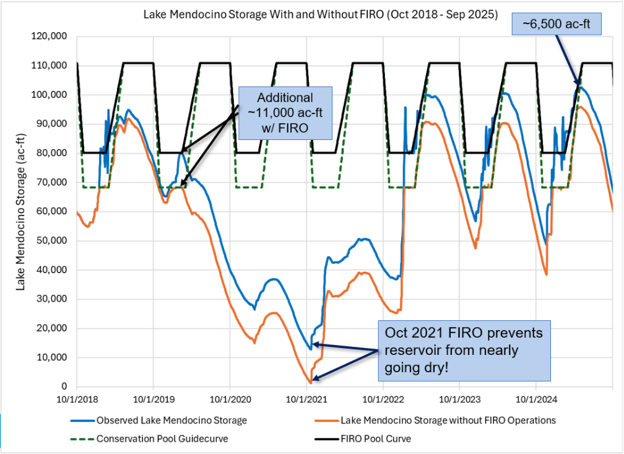
Based on the success of the viability assessments, the Army Corps began implementing FIRO on an interim bases through planned major deviations to the Water Control Manual from water year 2019 through 2025. During the past seven years of interim implementation of FIRO procedures, Lake Mendocino has experienced significant benefits to water supply without increasing downstream flooding. The major deviations were especially significant in water year 2020, which allowed the Army Corps to capture an additional 11,000 acre-feet of storage. The additional water captured in February 2020 likely prevented the reservoir from going dry in October 2021 as shown in the figure below.
Update of the Lake Mendocino Water Control Manual
Formal implementation of FIRO occurred in October 2025 with the Army Corps' release of the updated Water Control Manual for Coyote Valley Dam and Lake Mendocino. The updated Water Control Manual defined the operational rules that allow Army Corps water managers to utilize inflow forecasts information to inform reservoir releases. The first year of implementation, water year 2026, was very successful with the new Water Control Manual enabling operators to increase water storage by 20%, roughly equivalent to the water used by 45,000 households.
Expanding FIRO in the Russian River to Lake Sonoma
Based on the success of FIRO at Lake Mendocino, Sonoma Water has begun working with the Army Corps to evaluate the viability of FIRO at Lake Sonoma. Lake Sonoma is the second larger reservoir in the Russian River watershed and has more than double the water supply capacity (245,000 acre-feet) of Lake Mendocino and is the primary source of water for more than 600,000 residents throughout Sonoma and Marin counties. Beginning in 2023 Sonoma Water worked with the Army Corps to implement FIRO at Lake Sonoma on an interim basis through planned minor deviations to the Water Control Manual, which has increased storage for water supply and ecosystems by 8%. Further studies are being completed to potentially expand these benefits and update the Lake Sonoma Water Control Manual by 2030.
Sonoma Water supporting real time implementation of FIRO
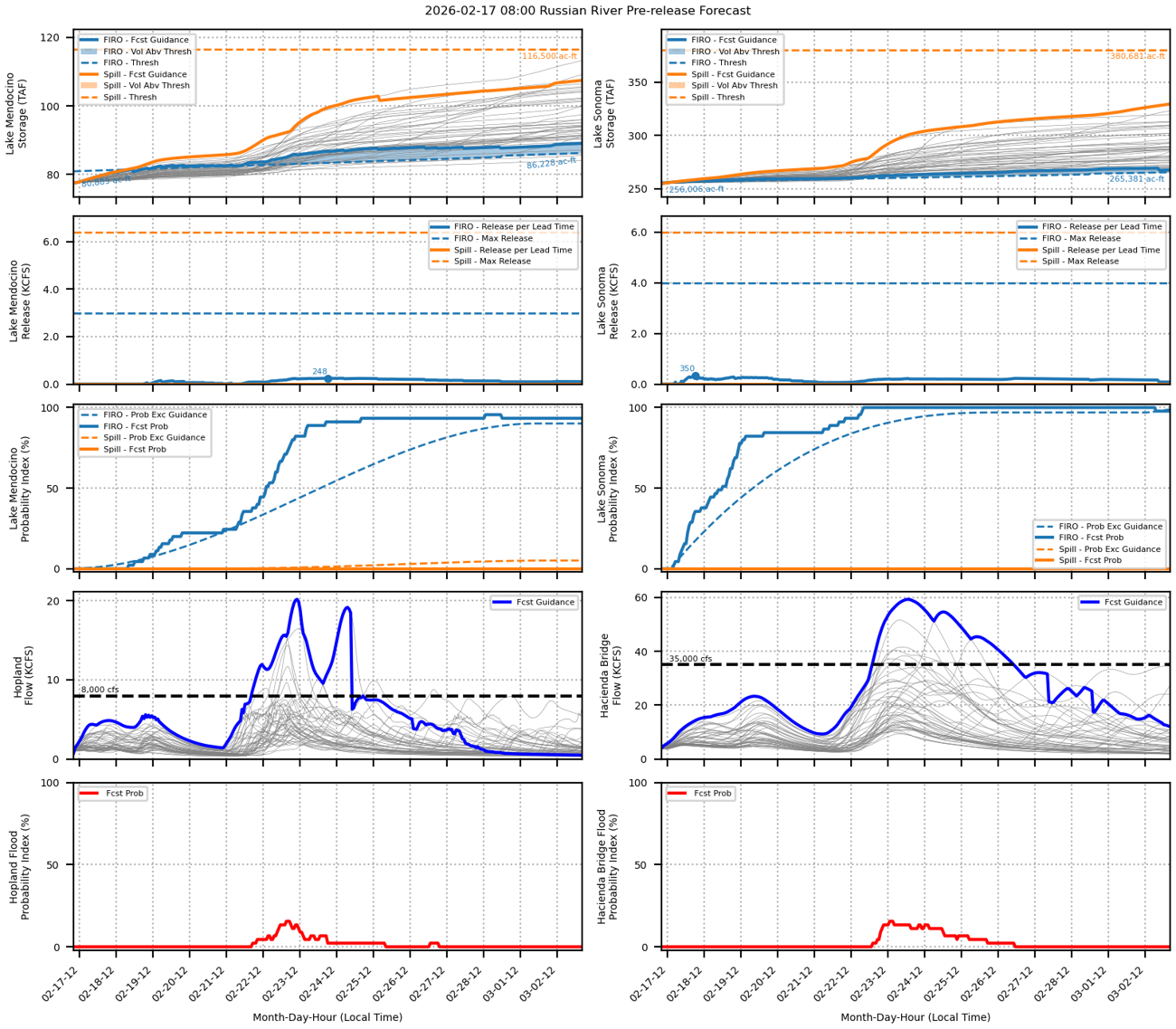
Sonoma Water supports real time operations under FIRO through providing daily forecasts using the Ensemble Forecast Operations decision support tool. The tool uses streamflow predictions from the National Weather Service to guide a risk-based approach to maintaining storage levels and managing downstream flows.
The example forecast below, from February 2026, shows reservoir storage levels at Lake Mendocino and Lake Sonoma, along with downstream flows in the Russian River, based on a range of possible forecast outcomes. Sonoma Water uses this information to formulate release recommendations for water managers at the Army Corps of Engineers to consider.
During winter and spring, Sonoma Water shares these forecasts with the Army Corps at least once a day, and multiple times a day during large storms.
Transferability to Other Reservoirs
FIRO is also being assessed at Prado Reservoir, Seven Oaks Reservoir, Nacimiento Reservoir, New Bullards Bar Reservoir, and Lake Oroville in California, as well as the Howard Hanson Dam in Washington. Lessons learned from these projects will be incorporated into a screening tool to help prioritize FIRO assessments at other reservoir sites across the United States.