
Q: What are PFAS?
PFAS (per- and polyfluoroalkyl substances) are a large group of man-made chemicals that have been used in consumer products and industrial applications since the 1940s. They are sometimes referred to as “forever chemicals” because they break down very slowly in the environment. They are very common in the environment because of their multiple uses, but the regulatory environment for these chemicals based on the evolving understanding of their health impacts has been changing rapidly.
Q: Where do PFAS come from?
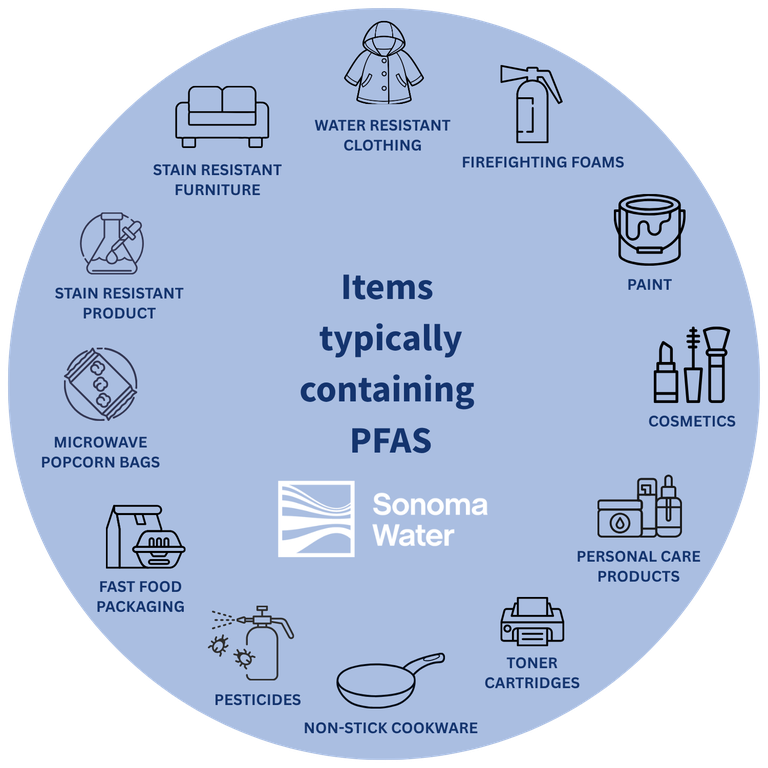
A: PFAS have historically been used in many common products and industrial applications, including firefighting foams, stain-resistant fabrics, food packaging and certain manufacturing processes. Because these compounds persist in the environment, they are now found in many locations across the country.
At this time, identifying a specific source in any particular area may require additional investigation and study.
Q: What are the regulations concerning PFAS?
On April 10, 2024, U.S. Environmental Protection Agency (EPA) established legally enforceable levels, called Maximum Contaminant Levels (MCLs), for six PFAS in drinking water: PFOA, PFOS, PFHxS, PFNA, and HFPO-DA as contaminants with individual MCLs, and PFAS mixtures containing at least two or more of PFHxS, PFNA, HFPO-DA, and PFBS using a Hazard Index MCL to account for the combined and co-occurring levels of these PFAS in drinking water. EPA also finalized health-based, non-enforceable Maximum Contaminant Level Goals (MCLGs) for these PFAS.
Abbreviation | Chemical name | Final MCL | Date Issued |
|---|---|---|---|
PFOA | Perfluorooctanoic acid | 4.0 ppt | April 10, 2024 |
PFOS | Perfluorooctanesulfonic acid | 4.0 ppt | April 10, 2024 |
PFHxS | Perfluorohexanesulfonic acid | 10 ppt | April 10, 2024 |
PFNA | Perfluorononanoic acid | 10 ppt | April 10, 2024 |
HFPO-DA (commonly known as GenX Chemicals) | Hexafluoropropylene oxide dimer acid | 10 ppt | April 10, 2024 |
Mixtures containing two or more of PFHxS, PFNA, HFPO-DA, and PFBS | Perfluoroheptanoic acid | 1 (unitless) | April 10, 2024 |
ppt = parts per trillion (also expressed as ng/L)
The EPA also set a combined hazard index limit of 1.0 for any combination of PFHxS, PFNA, HFPO-DA, and PFBS; the hazard index calculation would determine if the levels of these PFAS as a mixture pose a potential risk.
Under the EPA’s regulation, (Per- and Polyfluoroalkyl Substances (PFAS) | US EPA), public water systems must monitor for these PFAS compounds and complete initial monitoring by 2027, followed by ongoing compliance monitoring and must comply with the regulation within five years.
In October 2022, the California State Water Resources Control Board’s Division of Drinking Water (DDW) issued notification levels and response levels for the following PFAS compounds; PFBS, PFHxS, PFHxA, PFOS, PFOA.
Abbreviation | Chemical name | Notification Level | Response Level | Date Issued |
|---|---|---|---|---|
PFOA | Perfluorooctanoic acid | 4.0 ppt | 10 ppt | October 29, 2025 |
PFOS | Perfluorooctanesulfonic acid | 4.0 ppt | 40 ppt | October 29, 2025 |
PFBS | Perfluorobutanesulfonic acid | 500 ppt | 5,000 ppt | March 5, 2021 |
PFHxS | Perfluorohexanesulfonic acid | 3.0 ppt | 10 ppt | October 29, 2025 |
PFHxA | Perfluorohexanoic acid | 1,000 ppt | 10,000 ppt | October 29, 2025 |
PFHpA | Perfluoroheptanoic acid | -- | -- | Requested |
Sonoma Water has annually monitored for PFAS compounds from 2019 until 2024 and then started the required quarterly monitoring in April 2024. Sonoma Water has not found concentrations in the water delivered to our community above the current state response and notification levels nor have we found concentrations above the maximum contaminant levels set by the EPA on April 10, 2024. Sonoma Water will continue to closely monitor the evolving regulations to ensure that we meet state and federal requirements.
Q: Why are we hearing more about PFAS now?
A: Advances in laboratory testing now allow PFAS compounds to be detected at extremely low levels. At the same time, state and federal regulators have developed new drinking water standards and monitoring requirements for certain PFAS compounds.
Q: Are PFAS only a local issue?
A: No. PFAS have become a nationwide and worldwide issue affecting many water systems, groundwater basins, rivers, and lakes. Federal and state agencies across the country are currently evaluating monitoring, treatment and regulatory responses.
Q: Is my drinking water safe?
A: That depends on your water source.
If you receive water from a public water system, your water utility is required to monitor drinking water quality in accordance with state and federal requirements. Information regarding drinking water quality, including PFAS monitoring where applicable, is typically available in your utility’s annual Consumer Confidence Report (CCR) or Water Quality Report.
PFAS is only one of many possible groundwater contaminants. Depending on local conditions, private well owners may also wish to consider testing for additional constituents such as nitrates, bacteria, arsenic, manganese, volatile organic compounds (VOCs) or other contaminants of concern.
Customers with specific health concerns should consult their healthcare provider.
Q: What is Sonoma Water doing about PFAS?
A: Sonoma Water and regional water agencies are coordinating with regulatory agencies, and public health partners regarding PFAS monitoring, communication and public outreach efforts.
County staff are working to support consistent public information, coordination among agencies and public awareness regarding evolving PFAS regulations and monitoring activities.
Q: What are Notification Levels and Response Levels?
A: California has established Notification Levels and Response Levels for certain PFAS compounds.
- A Notification Level is a level at which water systems must notify governing agencies and, in some cases, customers.
- A Response Level is a higher level at which the State recommends that water systems take actions to reduce public exposure.
These levels are separate from federal drinking water standards established by the EPA.
Q: Should I stop drinking my tap water?
A: Customers should continue to follow guidance provided by their water utility and public health agencies. If monitoring identifies PFAS concentrations above applicable regulatory thresholds, the utility will provide public notification and information regarding any recommended actions.
Q: Should I buy bottled water or a home filtration system?
A: Customers should continue to follow guidance provided by their water utility and public health agencies.
If you receive water from a public water system, your utility will provide public notification and information regarding recommended actions if PFAS concentrations exceed applicable state or federal thresholds.
Any treatment device should be selected, installed, and maintained in accordance with manufacturer recommendations and applicable plumbing requirements.
Private well owners may wish to consult with qualified water quality professionals, laboratories, or licensed treatment specialists before installing treatment equipment.
Additional information regarding PFAS may be obtained from:
- U.S. Environmental Protection Agency
- California State Water Resources Control Board, Division of Drinking Water (DDW)
- Local water utilities and public health agencies