
Sonoma Water has initiated the process of collecting and reviewing video footage for the upcoming adult salmonid season.
Per the Biological Opinion and State Water Resources Control Board Order, the video counting system operates continuously within the fish ladder, as water flow conditions permit. Sonoma Water biologists and a team of technicians review the time-lapse images seven days a week and visit the site daily to clean and maintain the cameras.
The Chinook salmon currently returning to the Russian River are the offspring of wild parents that naturally spawned either in the upper 75 miles of the mainstem or in Dry Creek. It's important to note that there is no hatchery production of Chinook salmon in the Russian River, in contrast to the Russian River steelhead and coho populations, which consist of a mixture of hatchery-raised and wild individuals. These Chinook salmon, returning to the Russian River to begin their spawning process, typically range in age from two to four years. The spawning season usually commences in November and continues through January. After the eggs are deposited in the gravel, they undergo approximately two months of incubation before the fry emerge and embark on their downstream migration.
Results from Sonoma Water's trapping and marking studies have consistently revealed that the majority of juvenile Chinook salmon enter the Pacific Ocean by July of their inaugural year of life. This research provides valuable insights into the early stages of the salmonid lifecycle in the Russian River.
Previous Year's Totals
The number of adult Chinook salmon observed on the underwater camera located at the Mirabel inflatable dam from 2000-2025. The camera was not operated at the Mirabel dam in 2014 and 2015 because the site was under construction in order to construct the new fish screens and ladder. Counts were not obtained in 2021 because early season storms precluded camera operations beyond October 23.
Sonoma Water staff installed an underwater video camera at the Mirabel dam on August 21, 2025, to monitor adult salmon and steelhead that return to the Russian River to spawn. The camera is located in the fish ladder that provides fish passage around the Mirabel dam and can only be operated when the dam is inflated. The camera was operated until mid-November when the dam was deflated for the season. All the video from the Mirabel fish ladder has been reviewed and the preliminary Chinook count for 2025 is 4,175 (this number will shift slightly as we further QA/QC the data). This is the fifth highest count for the 23-year data set. The long-term average of adult Chinook salmon is 2,633. The camera was removed on November 13, 2025 which is earlier than typical (median deflation date of the dam is 12/7). In the last 23 years this was the second earliest the camera was removed. The high number of Chinook observed in 2025 over a shorter than typical monitoring season suggests that the Chinook return in 2025 was very strong. In addition to Chinook, 90 adult coho and 7 steelhead were observed on the video camera. Mirabel video counts are not good indicators of the strength of the coho and steelhead runs because much of the spawning for coho is downstream of the Mirabel dam and steelhead typically return later in the year when the dam is deflated.
Below is a graph comparing Chinook salmon counts from the video monitoring system from prior years.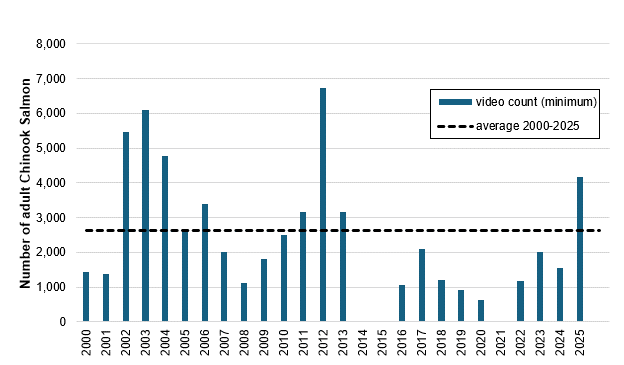

*Video cameras were reinstalled and operated from 4/1-6/27/2007 but no Chinook were observed.
**Video cameras not operated in 2014 and 2015 because the site was under construction in order to construct the new fish screens and ladder.
***Typically 1 camera is operated in both fish ladders but in 2016 a video camera was only operated in the east ladder for the final 10 days of the season.